

Almost any two trademarks could confuse someone, somewhere. If that were the test, very few marks would ever register. Section 2(d) asks a narrower question: is confusion likely? That word does real work, and it is one of the most useful tools an applicant has when answering a refusal.
What the statute actually says
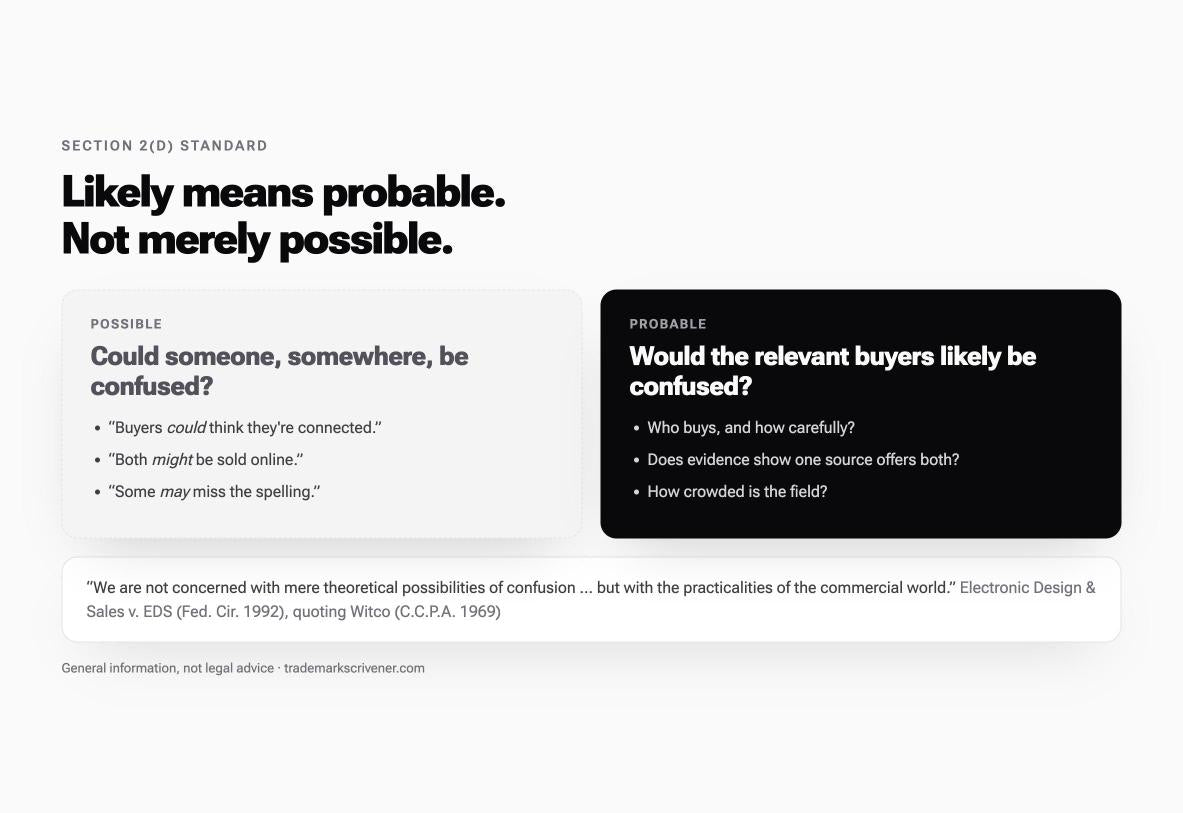
Section 2(d) of the Trademark Act lets the USPTO refuse a mark that so resembles a registered mark "as to be likely, when used on or in connection with the goods of the applicant, to cause confusion, or to cause mistake, or to deceive." The standard is likelihood. It is not certainty, and it is not mere possibility.
The Federal Circuit put it plainly, quoting its predecessor court: "We are not concerned with mere theoretical possibilities of confusion, deception, or mistake or with de minimis situations but with the practicalities of the commercial world, with which the trademark laws deal." Electronic Design & Sales, Inc. v. Electronic Data Systems Corp., 954 F.2d 713 (Fed. Cir. 1992) (quoting Witco Chemical Co. v. Whitfield Chemical Co., 418 F.2d 1403 (C.C.P.A. 1969)).
Possible versus probable, in practice
A "possibility" argument usually sounds like one of these:
- "A consumer could think the two companies are connected."
- "Both products might be sold online."
- "Some buyers may not notice the difference in spelling."
Each of these describes something that can happen. None of them shows that it is likely to happen among the relevant buyers, in the real marketplace, for the goods as identified. A probability analysis asks different questions:
- Who actually buys these goods, and how carefully?
- Does the evidence show that the same company commonly offers both kinds of goods under one mark?
- How many other businesses already use similar marks for similar goods, so that buyers are used to telling them apart?
- Do the marks, compared as a whole, create the same commercial impression?
Where the difference shows up in a refusal
Relatedness of goods. The weakest refusals often rest on a chain of possibilities: the goods could be sold together, used together, or bought by the same person. The Federal Circuit has rejected that approach. In In re St. Helena Hospital, 774 F.3d 747 (Fed. Cir. 2014), it reversed a refusal of TAKETEN for hospital-based health programs over TAKE 10! for printed fitness materials, holding that the fact that goods and services may be used together does not, on its own, show relatedness.
Food and restaurants. Where the question is whether food products and restaurant services are related, the case law requires "something more" than the fact that both involve food. In re Coors Brewing Co., 343 F.3d 1340 (Fed. Cir. 2003). In April 2026 the Board applied that rule to reverse a refusal of DAILY HARVEST CAFE over DAILY HARVEST for packaged foods, finding three or four examples of restaurants selling packaged goods "far from what would be considered numerous or substantial." In re Daily Harvest Café, Serial No. 98269684 (T.T.A.B. Apr. 2, 2026) (not precedential).
Near-identical names. In March 2026 the Board reversed a refusal of CASA BLANCA for tequila over CASABLANCA for wine. The marks were nearly identical, but the record did not show that buyers would expect tequila and wine to come from the same source. In re Lucien G. Lallouz, Serial No. 90782980 (T.T.A.B. Mar. 27, 2026) (not precedential). Identical words made confusion possible. The evidence did not make it probable.
DuPont factor 12: the extent of potential confusion
One of the thirteen DuPont factors asks directly whether potential confusion is de minimis or substantial. It rarely decides a case on its own, but it frames every other factor. A response that shows the realistic overlap between two businesses is small, supported by evidence about buyers and channels, is making a probability argument.
The counterweight you should know about
Probability cuts both ways. The Board compares the goods as written in the application and the registration, not as they are sold today. Where those descriptions are broad, the Board presumes the goods move in all normal channels to all usual buyers. And in a close case, doubt is resolved in favor of the registrant. In re Hyper Shoppes (Ohio), Inc., 837 F.2d 463 (Fed. Cir. 1988). A probability argument has to be built on the record, not on how different the two brands feel.
How to use this in a response
- List the examiner's inferences. For each conclusion in the Office Action, ask whether the attached evidence proves it or only makes it conceivable.
- Count the evidence. Two websites and a recipe are a different record from dozens of third-party registrations covering both goods.
- Replace "could" with facts. Answer each possibility with evidence: who buys, how they buy, how crowded the field is.
- Measure the result. Decide whether the refusal, taken as a whole, crosses from possible to probable.
That last step is what the TRACE™ Report is built for. It scores a Section 2(d) refusal across nine factors and 180 benchmarks calibrated to more than 600 decided TTAB cases. Below 7.00 on the Confusion Index, the refusal is contestable; at or above it, confusion is treated as probable. It costs $25, arrives within 24 hours, and is credited in full if you go on to respond.
Trademark Scrivener is an independent trademark administrator, not a law firm. This article is general information about USPTO procedure, not legal advice. Non-precedential decisions are summarized for illustration. The Confusion Index is a proprietary metric, not a USPTO or TTAB standard.