

If your trademark application came back with a Section 2(d) refusal, the examining attorney has decided your mark is "likely to cause confusion" with a mark that is already registered. That phrase sounds like a verdict. It is actually the end of a structured analysis, and every step of that analysis can be tested.
This guide walks through how the USPTO decides likelihood of confusion, which factors actually carry a refusal, and what three refusals overturned by the Trademark Trial and Appeal Board in 2026 show about where examiners' cases break down.
Where "likelihood of confusion" comes from
Section 2(d) of the Trademark Act lets the USPTO refuse a mark that so resembles a registered mark that, used on the applicant's goods or services, it is likely to cause confusion, mistake or deception. Two points matter from the start:
- Actual confusion is not required. The question is whether confusion is likely, judged from the application and the registration as written.
- The test is about source. The concern is not that buyers mix up two products, but that they wrongly assume both come from the same company, or a related one.
The 13 DuPont factors
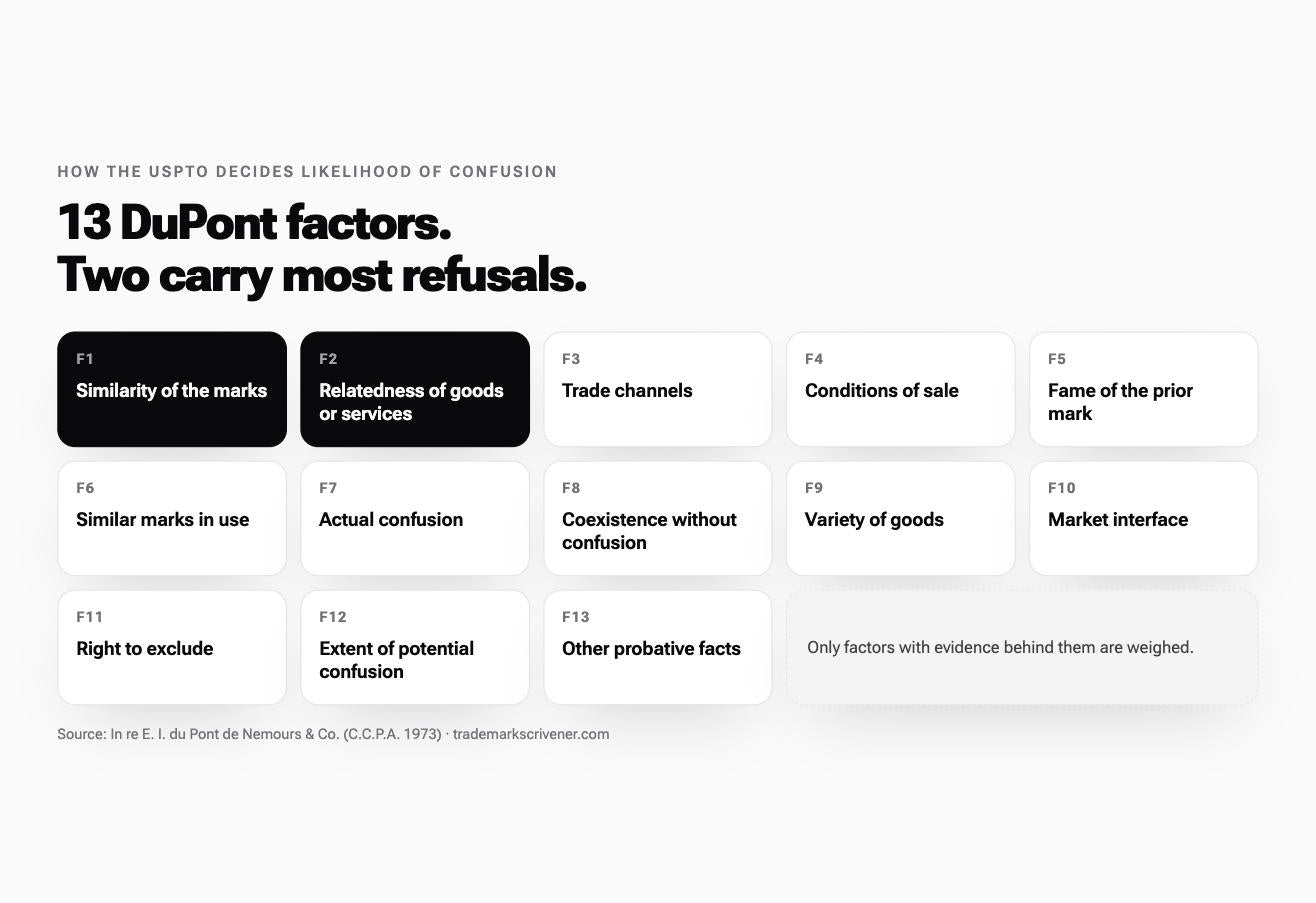
Examiners and the Board decide 2(d) cases using the factors listed in In re E. I. du Pont de Nemours & Co., a 1973 decision of the Court of Customs and Patent Appeals. There are thirteen, but not every factor is relevant in every case, and the Board weighs only those with evidence behind them.
- Similarity of the marks in appearance, sound, meaning and commercial impression
- Relatedness of the goods or services
- Similarity of trade channels
- Conditions of sale: impulse purchase versus careful, sophisticated buying
- Fame of the prior mark
- Number and nature of similar marks in use on similar goods
- Nature and extent of any actual confusion
- How long the marks have coexisted without actual confusion
- Variety of goods on which the prior mark is used
- Market interface between the two owners, such as a consent agreement
- The applicant's right to exclude others
- Extent of potential confusion
- Any other established fact probative of the effect of use
In practice, most refusals rest on the first two: the marks look or sound alike, and the goods are related. That is also where most successful responses aim.
Factor 1: the marks are compared as a whole
Examiners often focus on a "dominant" part of each mark, especially when the rest has been disclaimed. That is allowed, but the final comparison must be of the marks in their entirety, including design elements, stylization and the meaning a buyer would actually take away.
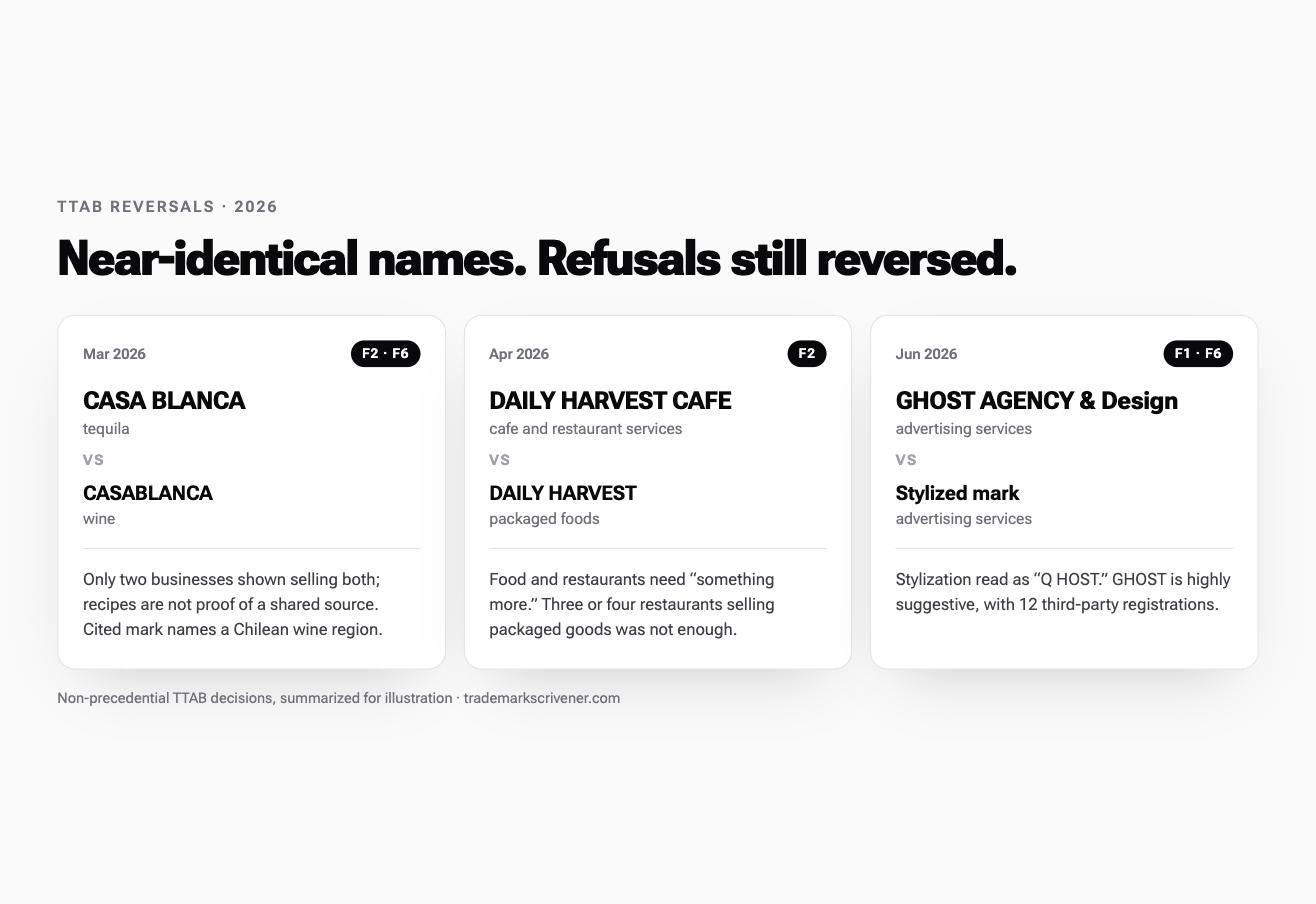
Example: GHOST AGENCY & Design (June 2026). The applicant sought to register GHOST AGENCY & Design for advertising and marketing services, with AGENCY disclaimed. The examiner treated GHOST as the dominant element of both marks. The Board disagreed. It found the stylized first letter of the cited mark reads as a lowercase "q," giving that mark the impression of "Q HOST," and that the applicant's stylization created a different commercial impression. The services overlapped, and the refusal was still reversed. In re The Ghost Agency, Inc., Serial No. 98709623 (T.T.A.B. June 18, 2026) (not precedential).
Factor 2: "both are food" is not enough
Relatedness has to be proven with evidence: third-party registrations covering both kinds of goods, websites showing one company selling both under one mark, and similar proof. The amount and quality of that evidence is where many refusals are weakest.
Example: CASA BLANCA for tequila (March 2026). The cited mark was CASABLANCA for wine. The Board agreed the marks were nearly identical and that the drinks move through the same channels. But the examiner had shown only two businesses selling both under the same mark, no registrations covering both, and a handful of cocktail recipes. The Board held that a recipe calling for two drinks does not show buyers believe they come from the same source, and found the goods not proven related. In re Lucien G. Lallouz, Serial No. 90782980 (T.T.A.B. Mar. 27, 2026) (not precedential).
Example: DAILY HARVEST CAFE (April 2026). The applicant sought DAILY HARVEST CAFE for cafe and restaurant services. The cited DAILY HARVEST registrations covered packaged foods and beverages. The Board found the marks' lead words identical, and still reversed. When the question is whether food products and restaurant services are related, the record needs "something more" than the fact that both involve food. Three or four restaurants selling packaged goods was "far from what would be considered numerous or substantial." In re Daily Harvest Café, Serial No. 98269684 (T.T.A.B. Apr. 2, 2026) (not precedential).
Factor 6: a crowded field narrows the cited mark
If many businesses already use a word for similar goods or services, buyers learn to tell those marks apart by their other elements, and each mark gets a narrower scope of protection. Evidence can show a term is conceptually weak (it describes or suggests something about the goods) or commercially weak (many others use it).
Both earlier examples turned partly on this. In GHOST AGENCY, the Board counted 12 third-party registrations for identical or overlapping services and found GHOST "highly suggestive" of ghost-written, white-label marketing work. In CASA BLANCA, more than 1,200 uses of "Casablanca Valley" to name a Chilean wine region made the cited mark conceptually weak for wine.
Factors 3 and 4: channels and careful buyers
When the identification of goods in the application and the registration has no limits on where or to whom the goods are sold, the Board presumes they move through all normal channels to all usual buyers. That is why trade-channel arguments rarely win on their own; in CASA BLANCA, the applicant's point that wine and spirits sit in different aisles did not persuade the Board.
Conditions of sale can help when the goods are expensive or bought after careful research, and when the buyers are professionals. The standard is the least sophisticated potential purchaser, so the argument needs evidence about who actually buys and how, not a general claim that customers are careful.
How to read your own refusal
Before deciding anything, go through the Office Action with these questions:
- Which registration is cited, and is it still alive? Look it up in TSDR. Check its status, its owner, and whether maintenance filings are due.
- Which part of each mark did the examiner call dominant? Ask whether that reading holds when the marks are compared as a whole, with design and meaning included.
- What evidence of relatedness is attached? Count it. Two or three websites or a few registrations is a different record from dozens.
- How many others use the shared word? Search the register for the same term on similar goods. A crowded field is evidence you can file.
- Could the goods be narrowed? A precise identification can remove the overlap the refusal depends on.
Common mistakes in 2(d) responses
- Arguing the brand, not the record. Explaining how different your company, logo or story feels does not answer the examiner's evidence.
- Relying on actual use in the market. The comparison is based on the goods as written in the application and registration, not on how either business operates today.
- Ignoring the disclaimed words. Disclaimed matter still counts in the overall impression, but it rarely distinguishes marks by itself.
- Filing third-party marks without context. Registrations for unrelated goods, or dead registrations, carry little weight. The GHOST AGENCY Board set many aside and relied on the 12 that covered overlapping services.
- Missing the deadline. A late response means abandonment, however strong the argument would have been.
What the three reversals have in common
- Identical or near-identical words did not decide the case. In all three, the key words matched, or nearly matched.
- The examiner's evidence was tested, not accepted. The weak points were thin relatedness evidence and a cited mark weaker than it looked.
- The winning arguments were specific. Each response went factor by factor with evidence, not general statements that the brands are different.
Your response deadline
You generally have three months from the Office Action's issue date to respond, and you can request one three-month extension for a fee. Check the exact deadline in the Office Action and in TSDR. If the deadline passes without a response, the application is abandoned.

How to decide what to do next
There are four ways to answer a 2(d) refusal: argue against it on the factors, narrow your goods or services, get a consent agreement from the owner of the cited mark, or challenge the cited registration if it is unused or lapsing. Our guide to the four options covers each one.
The harder question is which one fits your refusal. The TRACE™ Report scores a refusal across nine factors, using 180 benchmarks calibrated to more than 600 decided TTAB cases, and places the result on a single Confusion Index. At or above 7.0, confusion is treated as probable; below it, the refusal is contestable.
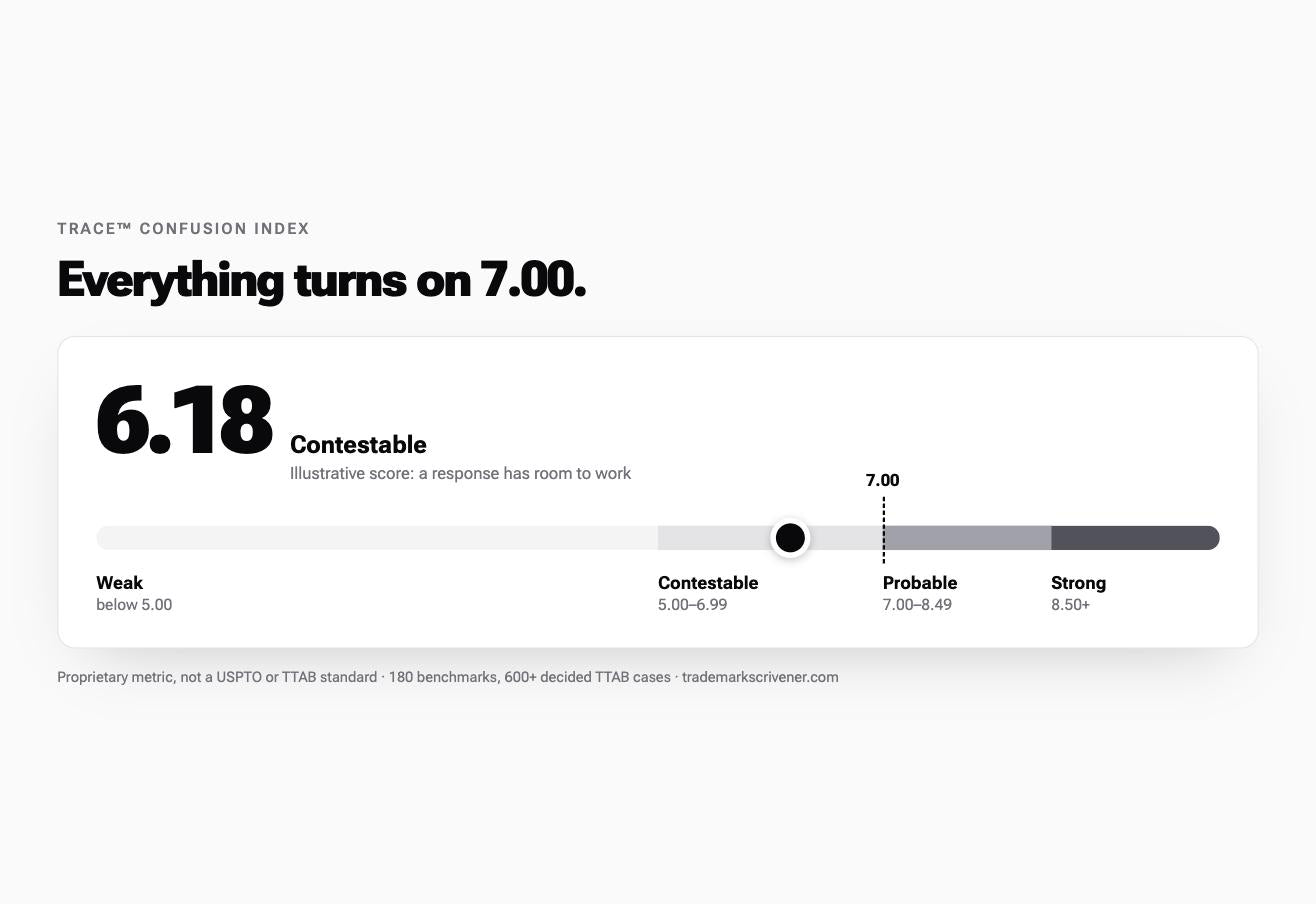
It costs $25, arrives within 24 hours, includes a 30-minute walkthrough, and is credited in full if you go on to respond.
Trademark Scrivener is an independent trademark administrator, not a law firm. This article is general information about USPTO procedure, not legal advice. The decisions discussed are non-precedential and are summarized for illustration.