

A Section 2(d) refusal reads with a lot of confidence. It is worth remembering who has to prove it. The USPTO does. And on both sides of the file, the same rule applies: arguments are not evidence.
The USPTO carries the burden
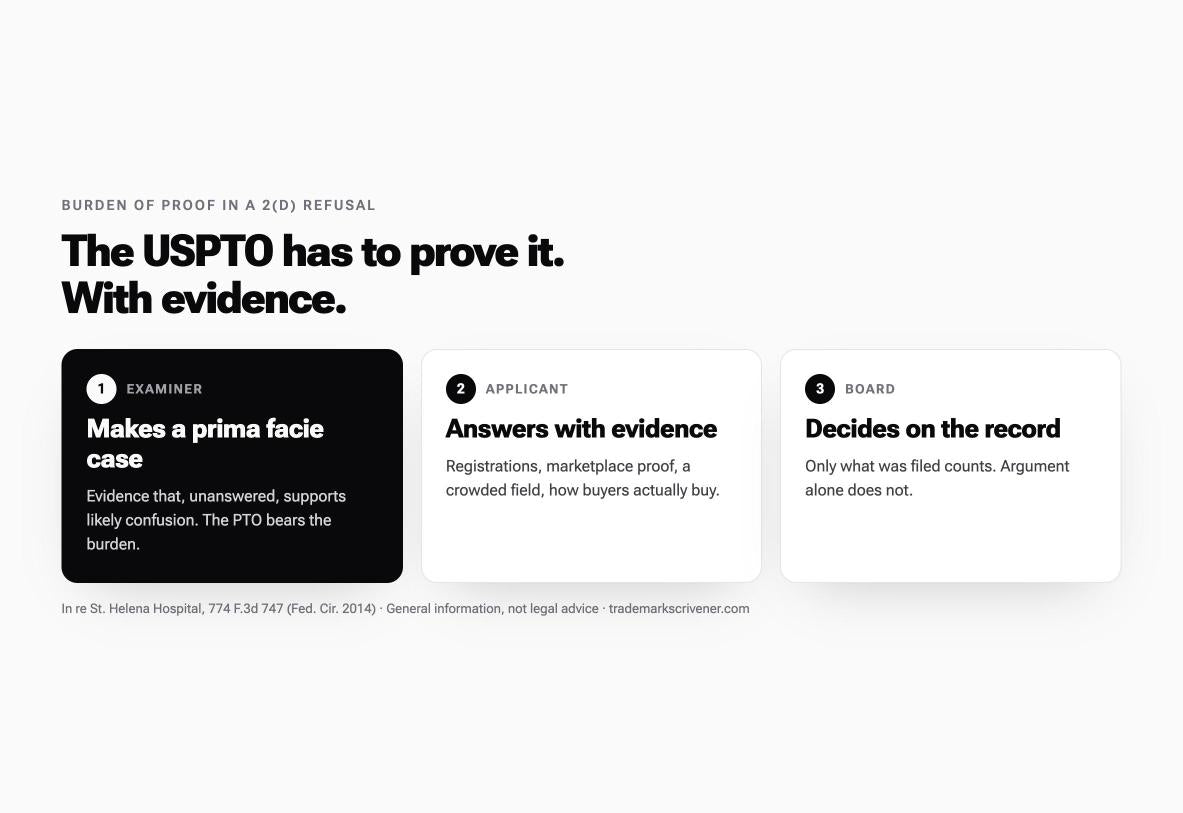
An applicant does not have to prove that its mark is registrable. The Office has to show why it is not. As the Federal Circuit put it in reversing a 2(d) refusal: "The PTO bears the burden of showing that a mark should not be registered." In re St. Helena Hospital, 774 F.3d 747 (Fed. Cir. 2014).
In practice, the examining attorney has to make out a prima facie case: evidence that, if unanswered, supports a finding that confusion is likely. The Office Action and its attachments are that case. Once it is made, the applicant needs to answer it with evidence of its own. But the starting point matters. If the examiner's case is thin, the refusal is weak before you write a word.
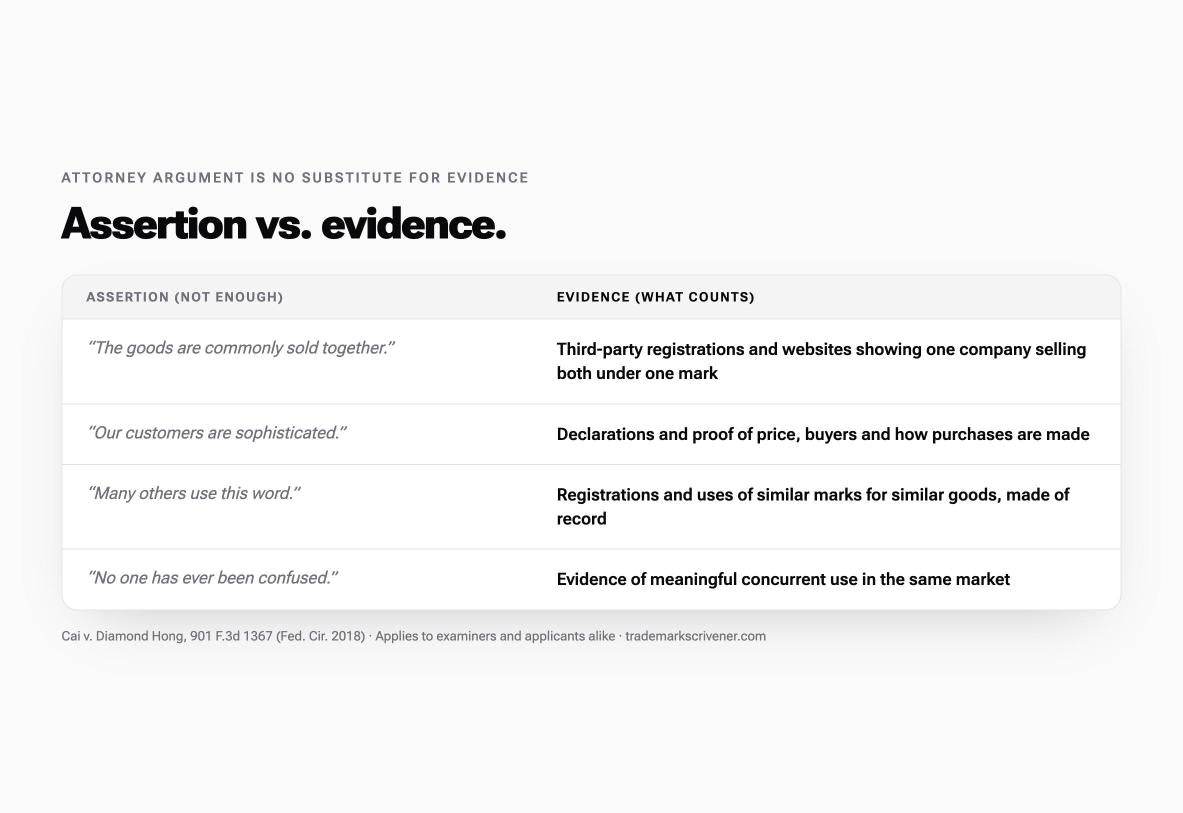
"Attorney argument is no substitute for evidence"
The Federal Circuit has said this repeatedly, including in a trademark case: "attorney argument is no substitute for evidence." Cai v. Diamond Hong, Inc., 901 F.3d 1367 (Fed. Cir. 2018). The Board applies it in ex parte appeals. In July 2026, for example, it rejected an applicant's claim that buyers of personal care products shop carefully, because nothing in the record supported it. In re DEO Co. LLC, Serial No. 99057517 (T.T.A.B. July 10, 2026) (not precedential).
The rule applies to examiners too. A statement in an Office Action that two kinds of goods are "commonly sold together" or "complementary" is an assertion. Without evidence behind it, it does not prove relatedness. In St. Helena, the court called the Board's "conclusory and unsupported supposition" about how carefully consumers choose health programs something that "merits no deference," and reversed.
What counts as evidence in a 2(d) case
- Third-party registrations that cover both kinds of goods or services, used to suggest a single source could offer both.
- Marketplace evidence: websites, catalogs and listings showing one company selling both kinds of goods under one mark.
- Registrations and uses of similar marks by others for similar goods, to show a crowded field and a weak cited mark.
- Dictionary definitions and articles showing what a term means to buyers.
- Declarations about how the goods are bought, by whom, and at what price, where the identification allows those facts to matter.
Every item has to be in the record. Screenshots should show the URL and the date they were captured. Evidence should be filed before any appeal, because the Board generally does not consider evidence added after an appeal is filed (37 C.F.R. § 2.142(d)).
How examiners' cases fall short
Three reversals from 2026 show the pattern.
- CASA BLANCA (tequila) vs. CASABLANCA (wine). Two examples of businesses selling both drinks, no registrations covering both, and a few cocktail recipes did not prove the goods related. In re Lucien G. Lallouz, Serial No. 90782980 (T.T.A.B. Mar. 27, 2026) (not precedential).
- DAILY HARVEST CAFE vs. DAILY HARVEST (packaged foods). Food and restaurant services need "something more," and three or four examples was not enough. In re Daily Harvest Café, Serial No. 98269684 (T.T.A.B. Apr. 2, 2026) (not precedential); see In re Coors Brewing Co., 343 F.3d 1340 (Fed. Cir. 2003).
- GHOST AGENCY & Design vs. a stylized mark. The examiner's view that GHOST dominated both marks gave way to how the cited mark actually reads and to 12 third-party registrations showing GHOST is weak for these services. In re The Ghost Agency, Inc., Serial No. 98709623 (T.T.A.B. June 18, 2026) (not precedential).
How applicants' responses fall short
- "Our customers are sophisticated." Without evidence, and with an unrestricted identification of goods, this is attorney argument. The Board looks to the least sophisticated potential purchaser.
- "There are many similar marks." A list of names in the response body is not evidence. Registrations and uses need to be made of record, and they need to cover similar goods.
- "We sell in different places." If the identification does not limit channels, the Board presumes normal channels, whatever the business does today.
- "No one has ever been confused." Without evidence of meaningful, concurrent use, the absence of reported confusion carries little weight.
Reading your Office Action with the burden in mind
- Separate assertions from exhibits. Mark every sentence in the refusal that is not backed by an attached exhibit.
- Test each exhibit. Does it show the same company offering both goods under the same mark, or just both goods existing?
- Build your own record. Answer each finding with evidence, not adjectives.
- File it on time. The response deadline is generally three months from the Office Action, with one paid three-month extension available.
A TRACE™ Report helps with the first two steps. It scores the refusal across nine factors and 180 benchmarks calibrated to more than 600 decided TTAB cases, and shows where the examiner's case is weakest. It costs $25, arrives within 24 hours, and is credited in full if you go on to respond.
Trademark Scrivener is an independent trademark administrator, not a law firm. This article is general information about USPTO procedure, not legal advice. Non-precedential decisions are summarized for illustration.